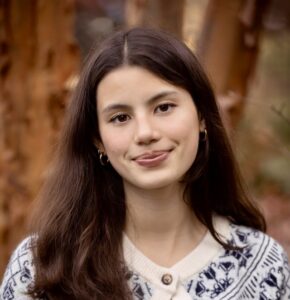
Pamina Burton, Student of Cecilia Cho
By Dr. Melinda Baird, Levine Piano Faculty
Pamina Burton, one of Levine’s outstanding Advanced Students, played a luminous recital to a full house of friends and supporters on Friday, May 22 at Levine’s Lang Recital Hall.
She began with a stately rendition of Bach’s second Partita in C minor. The sound was full but not overpowering, delicate and sensitively voiced, without being anemic. The slight pedaling of legato passages didn’t interfere with her appropriately baroque articulation of non-legato accompaniment. Some passages felt a little rushed but overall there was structure and purpose to the entire suite. The Allemande could move a little more to create the dance-like step motion but the swells and dips of the line were quite lovely. Clear entrances, light trills, and contrasts all contributed to an intentional sense of direction. The Courante was lively and articulate, creating sparkle through its running texture. Sarabande provided a calm respite, with careful attention to a bass line that can be hard to control in this slow tempo. Rondo was impressively fast, with shape of each entrance brilliantly executed. Clean yet careful, with each iteration full of character and charm. The final Capriccio was a driving, rhythmic and exciting conclusion to a brilliantly played Partita.
Read Pamina's full review
The F Major Etude of Chopin provided a vehicle for Pamina’s fingers to really fly. Each line had shape, with the right hand’s smooth undulating scales providing support for the left hand’s whimsical character. Debussy’s Petite Suite (featuring Casey Didden, student of Hyeweon Gessner) gave us an elegant and refined contrast to the complexities of Bach, and the brilliance of Chopin. The ensemble was well balanced, shaped, and charming. The color changes were evident, and clearly coordinated and executed. Pamina finished with a movement from a lesser known Balakirev Concerto. The flourishes and finger work were Rachmaninov-like in texture but the ballet dramatic scenes and changes could easily be experienced through Pamina’s rendition, with flourishes like scarves flying and showing us so many beautiful colors.
But the most touching and meaningful part of the recital came at the end when Pamina acknowledged the support of her family, friends, and most of all her teacher, Cecilia Cho. They clearly have a special relationship. Pamina is truly a product of many good teachers at Levine (beginning with former piano chair, Pamela Sverjensky). This capstone experience is a clear representation of the best Levine has to offer, and she has risen to the top. Brava, Pamina.
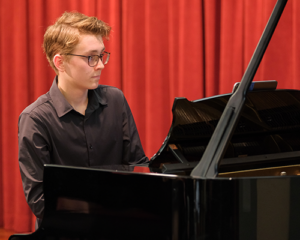
Sam Brose, Student of Jamila Tekalli Hanner
By Dr. Minji Kim, Levine Piano Faculty
As a teacher, one of the greatest joys is watching young musicians discover not only how to play the piano, but how to communicate through it. I first heard Sam Brose perform about two years ago and remember already being impressed by his exceptional musical sensitivity. Returning to hear his first full-length Advanced Student Recital this spring, I was struck not only by how much he had grown as a pianist, but also by the artistic maturity he has developed in such a short time. Knowing that he has been studying classical piano seriously for only a few years made the achievement all the more extraordinary.
Over the years, I’ve come to believe that polishing a piece of music is a little like building an imaginary world. As performers, we gradually learn every corner of that world. We know the personalities of its inhabitants, the relationships between them, the way each path leads to another, and why every building stands where it does. In musical terms, those inhabitants become the melodies, inner voices, harmonies, rhythms, colors, and silences. Once that world becomes real to the performer, every musical decision has a purpose—and that sense of intention becomes unmistakable to the audience. Throughout Sam’s recital, every phrase, every layer, and even the silences felt guided by that sense of intention.
Read Sam's full review
The recital opened with Stephen Hough’s Fanfare Toccata, a work commissioned for the 2022 Van Cliburn International Piano Competition. From the very first measures, Sam displayed extraordinary clarity and control. Every note sparkled with purpose, while his thoughtful use of silence created an unusual sense of anticipation. The lyrical middle section revealed another side of his artistry, unfolding with lush voicing, beautifully layered textures, and an intimate singing tone. Most impressive was the way he guided listeners through ever-changing colors without ever losing the thread of the music.
After the opening work, Sam briefly introduced the program and shared the inspiration behind several of the pieces. For a sophomore in high school giving his first solo recital, he spoke with remarkable ease and sincerity. His engaging comments immediately invited the audience into his musical imagination, setting a warm and personal tone for the rest of the recital.
Chopin’s Nocturne in D-flat Major, Op. 27 No. 2 offered perhaps the most personal glimpse into Sam’s artistic voice. Before performing, he described imagining a dancer practicing alone late at night, and that image lingered beautifully throughout his interpretation. His phrasing was remarkably flexible and sincere, shaped with an individuality that felt unmistakably his own. At moments, I found myself wishing he would allow the musical time to expand just slightly as the music approached its emotional climaxes. Rather than relying solely on increased intensity, allowing the tempo to breathe a little more could have given those climactic moments even greater emotional weight. Even so, I admired the confidence to present such a personal interpretation at such a young age.
Mozart’s Piano Sonata in D Major, K. 576 revealed another side of Sam’s musicianship. In the opening Allegro, I especially admired his lively rhythmic sense—one of the defining qualities of Classical style. Crisp articulation, sensitive pedaling, and carefully balanced voicing allowed every phrase to unfold naturally with elegance and clarity.
The Adagio displayed a maturity well beyond Sam’s years. His beautiful, rounded tone and intimate sound world suited the movement especially well, and he appeared completely absorbed in the music. There was a quiet restraint to his interpretation that felt entirely appropriate to Mozart’s style, lending the movement a sense of poise and maturity. The closing Allegretto sparkled with energy and wit. At times I wondered whether a slightly more relaxed tempo might have allowed the musical ideas to breathe a bit more naturally, but Sam’s rhythmic control and understanding of the sonata’s character never wavered.
Scriabin’s Sonata-Fantasy is one of my favorite works in the piano repertoire, so I listened with particular anticipation. I was especially drawn to the immersive sound world Sam created in the opening Andante. Transparent voicing and beautifully layered textures allowed the music’s luminous sonorities to bloom naturally.
The Presto was exhilarating without becoming chaotic. Even at an astonishing tempo, the intricate right-hand figurations remained remarkably clear. I occasionally wished for a fuller sonority in the loudest passages, with a slightly richer palette of sound and more generous pedaling, but the movement’s technical assurance and energy made for a compelling conclusion to the sonata.
The recital concluded with Ravel’s Une barque sur l’océan, coincidentally the same work I had first heard Sam perform nearly two years ago. While I remember being struck by his formidable technique then, hearing the piece again revealed just how much he has matured as a musician. His technical command was every bit as secure, but what captivated me even more was his increasingly refined ear for color, pacing, and atmosphere.
The long musical lines unfolded with admirable patience, while the shimmering sonorities and constantly shifting textures vividly suggested the movement of water. Even in the most virtuosic passages, Sam resisted the temptation to let excitement overpower the broader musical line, allowing the piece’s expansive landscape to unfold naturally. For me, it was the highlight of the evening—a performance that beautifully captured both his artistic growth and the qualities that make him such a compelling young musician.
As I reflected on the recital afterward, I realized that what impressed me most was not simply Sam’s technical accomplishment, considerable though it already is. Many gifted young pianists eventually learn to play quickly or brilliantly. What is much rarer is developing the patience and humility to let the music guide every artistic decision. I never had the sense that Sam was trying to impress the audience. Instead, every phrase reflected a genuine respect and affection for the music itself, and that sincerity was perhaps the recital’s greatest strength.
Looking around the hall at the conclusion of the recital, it was impossible not to notice the warmth surrounding the evening. Sam was clearly supported by an extraordinary community of family, friends, teachers, and fellow students who celebrated each moment with genuine excitement. Rather than feeling like a performance under scrutiny, the recital became a joyful shared musical experience. That atmosphere seemed to free Sam completely, allowing both performer and audience to simply enjoy making music together. Watching Sam’s artistic growth over the past two years has been both inspiring and exciting. What moved me most was not simply the musical world he had built, but the generosity with which he invited the audience inside it. I look forward to seeing how his artistic voice continues to mature in the years ahead.
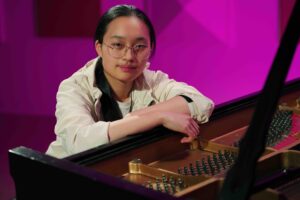
Davanee Li, Student of Dr. Wen-Yin Chan
By Dr. Rachel Chen, Levine Piano Faculty
On April 10th, 2026 at 7:30 PM, I had the honor of attending Davanee Li’s Advanced Recital at the NW Campus in Lang Hall. From the outset, it was clear that this program was not only ambitious but really personal. It felt like a true reflection of who Davanee is as both a musician and a person. I first met Davanee at the Indiana University Piano Academy in the summer of 2023, and later spent more time with her at Camp Levine in 2024. As her former piano camp counselor, it has been really meaningful to see how much she has grown over the years, especially watching her become more open and confident in how she expresses herself through music. When Davanee performs, there is just something special about it. This was easily one of the best pre-college recitals I have attended, and I feel grateful I got to be there.
Before the recital began, Davanee stood at the back of the hall alongside Dr. Sayaka Jordon and her teacher, Dr. Wen-Yin Chan, taking in the moment. When I said hi briefly, her excitement and sincerity were immediately clear. She opened the program with J.S. Bach’s Prelude and Fugue in E-flat Major, BWV 876. Beginning a recital with Bach is always a bold and grounding choice, setting a tone of clarity and discipline. Davanee approached the Prelude with careful attention to articulation and voicing, allowing each line to speak with intention. The Fugue was handled with admirable control; each entrance was clearly defined, and her sense of structure gave the work a strong architectural shape. Her playing demonstrated both respect for the style and a growing confidence in navigating contrapuntal textures.
Read Davanee's full review
After that, Davanee spoke to the audience with a heartfelt speech. She expressed gratitude to those present, as well as those watching virtually, and spoke candidly about her program. With her usual sense of humor, she introduced Beethoven’s Waldstein Sonata, joking that while it’s often considered one of the hardest sonatas, she didn’t find it particularly difficult, which made everyone laugh and perfectly captured her fearless spirit. She also shared that it was her mother’s birthday, which made the day even more meaningful and thanked her parents’ unwavering support. A particularly touching moment came when she acknowledged her first piano teacher, whose early guidance shaped her musical journey, and she also thanked her current teacher, Dr. Wen Yin Chen, and Levine’s piano department. Her words felt genuine and sincere, and we were all moved.
Davanee then launched into Beethoven’s Sonata No. 21 in C Major, Op. 53, “Waldstein.” This is one of the most intimidating sonatas in the entire Beethoven repertoire, and it is not often programmed by young pianists because of its stamina demands and technical difficulty. From the opening of the first movement (Allegro con brio), she established an energetic and forward-driving character. Her tempo was notably brisk, yet she maintained technical control and clarity, a testament to her strong technique and agility. The repeated chords and expansive passages were executed with precision, and her sense of momentum carried the movement convincingly. In the second movement (Introduzione), Davanee shifted into a more introspective sound world. The solemn, almost searching quality of the music was conveyed through sensitive phrasing and a refined touch. She allowed the harmonic tension to unfold naturally, creating a meaningful contrast with the outer movements. The final movement (Rondo: Allegretto moderato – Prestissimo) was both luminous and exhilarating. Davanee shaped the long melodic lines with care, and as the movement progressed, she built toward a thrilling conclusion. At moments, the tempo felt almost breathless, and my heart was racing right along with it. I was worried that it might be getting too fast to sustain, but she proved me wrong. The rapid passages in the coda were delivered with impressive velocity and control, highlighting her technical command while maintaining musical direction.
During intermission, I spoke with a couple of audience members who were clearly struck by the first half of the program. They kept mentioning how powerful her speech was and how much they felt pulled into her playing. One student noted that although they could not directly see her hands, but could see the hammers moving so fast that it was almost hard to believe. The second half of the program began with a noticeable shift in atmosphere, marked in part by Davanee’s outfit change. She added a sparkling jacket that reflected the more colorful and varied repertoire to come. This thoughtful attention to presentation underscored her artistic identity and willingness to break from convention. She began the second half of the concert with Schubert’s “Der Wanderer,” D. 489, a piece that offered a lyrical and introspective contrast to Beethoven’s intensity. Davanee captured the song-like quality of the work with a warm tone and sensitive phrasing, allowing the melody to sing naturally while maintaining a steady underlying Pulse.
Next came Rachmaninoff’s Six Moments Musicaux, Op. 16 No. 6. This piece demands both power and profound emotional depth, and Davanee rose to the challenge with a rich, full sound. She navigated the dense textures with remarkable clarity, shaping the climactic moments effectively while maintaining a strong sense of line throughout. The dynamic range in this work is immense, and the earth-shattering triple fortes were delivered with striking intensity and control. At the same time, she never lost sight of the music’s emotional core. Her playing was so moving that it almost brought me to tears. Her performance captured both the intensity and the more introspection side of Rachmaninoff’s writing.
She concluded the program with The Tom and Jerry Show by Hiromi Uehara, which was so much fun and an unexpected choice but it also felt completely true to who she is. It’s a jazzy, high-energy piece, and she played it with so much personality, rhythmic drive, and joy. It was infectious. It made for a bold and memorable ending to the recital, and definitely one of my favorite moments of the night. I had actually heard Davanee play this piece at last year’s Levine Gala, so it was really special getting to hear it again. It made me want to learn it myself. It was clear how much care and dedication had gone into preparing this recital. None of this would happen without the strong support and guidance of her teacher, Dr. Wen-Yin Chan and to the unwavering support of her family and community. I wish Davanee all the best in her continued studies and growth as both a musician and a person. As she begins her college journey at UF studying entomology, with aspirations to transfer to Cornell, I have no doubt she will continue to pursue her many passions. I hope she always keeps music as a source of expression and joy in her life.
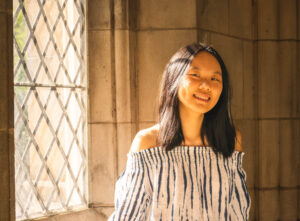
Yuhan Li, Student of Dr. Wen-Yin Chan
By Dr. Sean Cavanaugh, Levine Piano Faculty
The crowning achievement of a Levine piano student’s work is the Advanced Student Recital, which is offered by the piano department to students who have completed all 10 levels of the demanding curriculum, and earned the highest grade of distinction on their final jury. It is typical for the few dedicated students who make it this far on their Levine journey, to reach this Everest, near the end of their senior year in high school, after taking well over a decade to complete the countless recitals and juries to reach this summit. This was Yuhan Li’s second advanced recital, having completed all the level 10 requirements and earning her final distinction a year earlier than most.
Yuhan chose to begin her program with Beethoven’s Piano Sonata No. 31 in A-flat Major, Op. 110. This magical piece is a favorite of pianists for its intimacy, lyricism, and blend of Bach-like counterpoint with the introspection and unpredictability of Beethoven’s late style. Yuhan approached the piece with a great sense of reverence and maturity, taking her time to settle in before the opening chorale-like theme. Her playing of the first movement was very respectful of the score, honoring Beethoven’s strange and unexpected dynamic changes and his meticulous notation of slurs and staccati.
Read Yuhan's full review
The feisty second movement was a departure from the warmth of the first movement to the boisterous and bombastic, which Yuhan tackled with fire and vigor. The syncopated sforzandi and extreme changes in register and dynamics, along with the demanding passagework were handled very well, and felt like a jolt to a wake us up from the sacred holiness of the first movement. This energetic and spirited movement is believed to contain melodies of rough-and-tumble German drinking songs, which contrast with the reverence and spirituality of the surrounding first and third movements.
In the lengthy final movement, Yuhan and Beethoven took the listeners on a journey through various operatic-like scenes of sorrow, hope, despair, and finally rebirth. This movement is very difficult to pace, with the various tempo and key changes, as the music moves from scenes of extreme despair to hopeful renewal, only to fall back into despair. My only reservation with Yuhan’s playing here is that I wish she would have taken even more time to linger in the sorrowful moments of this journey, which would have made the following moments of hope and rebirth even sweeter.
The sonata concludes with a slow return to life. The music gradually transforms from despair through an assortment of fugal techniques and quirky rhythms, picking up tempo, growing into excitement, and eventually – exhilaration and triumph. Yuhan’s final chord was followed by a well-deserved thunderous applause from a packed audience.
Following a brief intermission, Yuhan’s second selection was about as different from Beethoven as one could imagine – two movements from contemporary composer Paul Schoenfeld’s Peccadilloes. The first movement, titled Allemande (a reference to the opening movement of a Baroque dance suite) was very appealing. Yuhan’s playing was full of charm and finesse here, as Schoenfeld’s harmonies weaved in and out of interesting and unusual places. Yuhan then played the final movement of the suite, titled Boogie. Schoenfeld is most known for his jazz-like pieces, with syncopated rhythms, interesting harmonies, and demanding technical hurdles, which were all on full display here. Yuhan’s dry rhythmic approach to the perpetuum mobile boogie movement was very appropriate, and left the audience tapping their feet along with her from the first note to the last.
The final piece on the program was Franz Liszt’s ever exciting Spanish Rhapsody. Fingers flew, scales sparkled, and octaves pounded. Yuhan was well-equipped to tackle this romantic-era behemoth, rising to the occasion with flair and panache in one of Liszt’s most demanding works.
As with the final movement of the previously played Beethoven, one of the great challenges of Liszt’s longer pieces is the pacing. Each peak and valley of the music needs to feel unique, yet still a small part of the larger structure to maintain the long arc of the piece. Yuhan had clearly accomplished the incredibly difficult task of mastering all the technical traps that Liszt had laid for her. Her octaves were especially impressive. Playing some of these romantic-era beasts takes years of living with the music and the composer to convey a clear sense of the large-scale structure of the music and to craft one’s own personal statement on the music. Yuhan is clearly an incredibly gifted pianist, and this is only the beginning of her journey with this piece, and others like it, and I was proud to be there for it.
The immediate standing ovation Yuhan received upon reaching the end of the daunting coda of the Liszt Rhapsody was well-deserved, and a testament to her incredible talent. It was clear how much preparation had gone into this recital, and how much of a wonderful support system of friends, family, and teachers had been there to support her that night and throughout her many successful years at Levine.
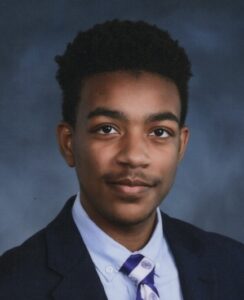
Adam Perry, Student of Andrea Sagripanti
By Dr. Yuhe Wang, Levine Piano Faculty
Presenting an Advanced Recital at Levine is a remarkable achievement, and Adam Perry’s program reflected just how much dedication, maturity, and long-term commitment such an occasion requires. For students who have spent years balancing school, family life, and many other responsibilities, arriving at this milestone is no small thing. Adam’s recital carried that sense of significance from the start: this was not only a demanding solo program, but also the culmination of many years of thoughtful work, perseverance, and artistic growth.
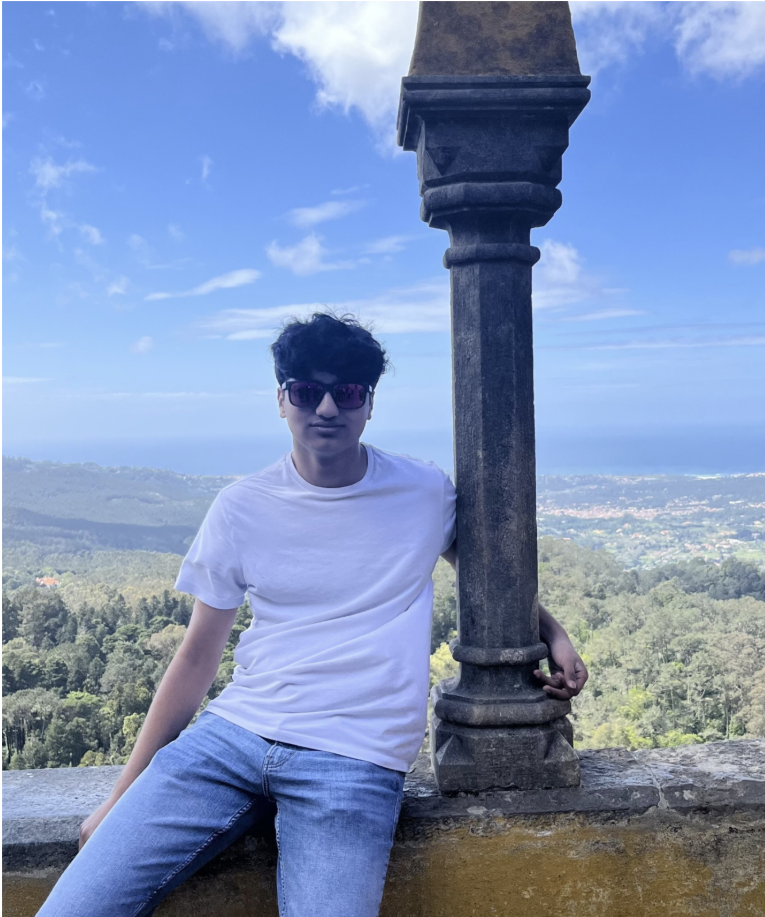
Adam’s Levine background alone signals the breadth of his musicianship. Having studied piano here since early childhood, participated in performance classes and theory study, and also pursued violin and organ, he brings to the piano an unusually broad musical perspective. That wider experience could be felt in the seriousness and poise of his recital playing. He maintained a calm and composed stage presence throughout, with a stable posture and an economy of movement that allowed the music to remain the focus. Just as notable was the security of his memorization. In a program of this length and difficulty, his consistency and concentration were especially impressive, and they supported a strong sense of continuity from beginning to end.
Read Adam's full review
Opening with the Busoni arrangement of Bach’s Chaconne in D minor was an ambitious and impressive choice. This is music that asks for both architectural command and expressive restraint, and Adam approached it with clear purpose. The work’s grand design can overwhelm a young performer, yet he sustained its momentum with concentration and conviction. He showed an ability to differentiate textures and layers, and each variation had a distinct character. His control of pedal contributed to a varied palette of sound. At times, a lighter touch and greater clarity in faster passages would allow more detail to come through, but his grasp of the overall structure was evident. It was a bold way to begin the recital and immediately established the seriousness of his musical intentions.
Beethoven’s Sonata No. 5 in C minor, Op. 10 No. 1 followed naturally, and Adam seemed very much at home in its dramatic world. The first movement benefited from clear dynamic contrasts and rhythmic energy. The second movement offered a sense of lyricism and reflection, supported by a thoughtful tempo choice. As this repertoire continues to deepen, more shaping within phrases and a stronger sense of inner direction will help sustain the musical line, particularly in slower passages. In the finale, he conveyed the restless drive that makes this sonata so compelling. Some passages moved ahead of the pulse, yet his commitment and stamina in maintaining the movement’s intensity were clear.
Chopin’s Ballade No. 3 in A-flat Major revealed another side of Adam’s playing. Here, the challenge is not only virtuosity, but storytelling: the performer must guide the listener through changing moods while preserving a sense of line and inevitability. Adam brought a singing, unforced quality to the Ballade’s opening theme, and he navigated its more animated sections with control. The middle section, in particular, showed a smooth legato and a sense of breath in the phrasing. With further exploration of pacing and contrast, the narrative character of the piece can become even more vivid and expansive.
To close with Debussy’s Clair de lune was a sensitive programming decision. After the scale and intensity of the earlier works, this piece invited a more intimate and reflective atmosphere. Adam approached it with care and gentleness, allowing the music’s familiar beauty to unfold naturally. Continued attention to rhythmic flow and tonal refinement will help the sound move more freely and with greater nuance. It served as a graceful conclusion to a thoughtfully constructed program.
Adam acknowledged the audience’s warm response with an encore: Rachmaninoff’s Prelude in G minor. This well-chosen addition brought a renewed sense of energy and rhythmic vitality to the close of the evening. The bold character and sweeping gestures of the piece suited him well, and he delivered it with confidence, leaving a vivid and memorable final impression.
What made the recital most meaningful, however, was the sense of a young musician reaching an important milestone with sincerity and focus. Across the entire program, Adam demonstrated impressive stamina, concentration, and commitment, qualities that are essential for a recital of this scope. His achievement reflects not only his own discipline, but also the guidance of his teacher, Andrea Sagripanti, and the support of his family and musical community. To arrive at this level after so many years of study is rare, and Adam should be proud of what he has accomplished. This recital stands as a testament to his growth at Levine and points clearly toward continued musical engagement in the years ahead.
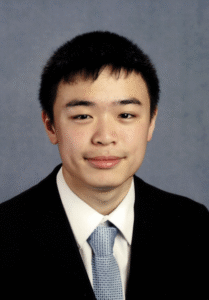
William Wu, Student of Marina Alekseyeva
By Dr. Luke Ratcliffe, Levine Piano Faculty
This past weekend, I had the pleasure of attending William Wu’s Advanced Student Recital at Levine’s NWDC campus, and I came away genuinely impressed by both the intensity of the program and the musical conviction behind it. There is something particularly exciting about hearing a young pianist, still in high school, playing the signature warhorses of the piano repertoire—works which demand both total command and imaginative color, stamina, and artistic maturity. William’s performance demonstrated all these qualities, offering an afternoon of music-making that was thoughtful, expressive, and quite engaging. This was also the first time I heard the new Steinway concert grand on full display and William did not disappoint!
The recital opened with Frederic Chopin’s Andante spianato et Grande Polonaise brillante, Op. 22, one of the composer’s most elegant and dazzling concert works. William approached the opening Andante spianato with admirable restraint and lyricism. The long melodic lines unfolded naturally, with a singing tone and an unforced sense of rubato that allowed the music’s poetic atmosphere to emerge. Rather than over-romanticizing the textures, he allowed Chopin’s writing to speak with clarity and simplicity, creating a feeling of floating and suspended time.
Read William's full review
The transition into the Grande Polonaise brillante brought an immediate shift in character. Here William revealed another side of his playing—big scale, orchestral, and full of confidence. The virtuosic passagework sparkled with enthusiasm while maintaining musical shape and direction. Particularly effective was his sense of rhythmic vitality; the dance character remained present even amid the most technically demanding moments. He projected the work’s theatrical brilliance without sacrificing elegance, capturing the spirit of Chopin’s uniquely aristocratic virtuosity. Often, he would crack a smile while playing!
The second half of the program featured Rachmaninoff’s Piano Concerto No. 2 in C Minor, Op. 18. A performance of a Rachmaninoff Concerto is a daunting undertaking for any pianist. From the opening chords, William established an atmosphere of breadth and intensity before launching into the concerto’s expansive musical landscape.
Throughout the first movement, William demonstrated impressive control over the large-scale architecture of the work. The sweeping melodies were projected generously, and moments of heightened drama carried real emotional weight. Particularly compelling was his willingness to embrace contrast: moments of power gave way to passages of introspection and tenderness without feeling disconnected.
The Adagio sostenuto offered some of the evening’s most memorable playing. William allowed the lyricism to unfold with warmth and sincerity, finding a beautiful balance between forward motion and reflection. There was a sense of openness and vulnerability in the quieter moments that gave the movement emotional resonance. It was not tossed to-and-fro by heavy rubato. Rather, it maintained a steady pulse and allowed careful phrasing to do the expressive work.
The finale brought the recital to an exhilarating conclusion. William navigated the movement’s technical and musical demands with determination and energy, sustaining momentum through its episodic structure while building toward a compelling finish. The closing pages carried with it a feeling of triumph and release that felt fully earned after the emotional journey of the concerto.
Of course, performances of this caliber are never created in isolation. It was evident throughout the afternoon that considerable thought, preparation, and dedication had gone into shaping this recital. Credit is due to his teacher, Marina Alekseyeva, whose guidance was reflected not only in William’s technical preparation but also in the seriousness and artistic care behind the program. Surrounded by supportive family, friends, and teachers, William presented a recital that reflected both this achievement and his continued growth. It was a memorable afternoon of music-making, and I look forward to following his development as a pianist.